
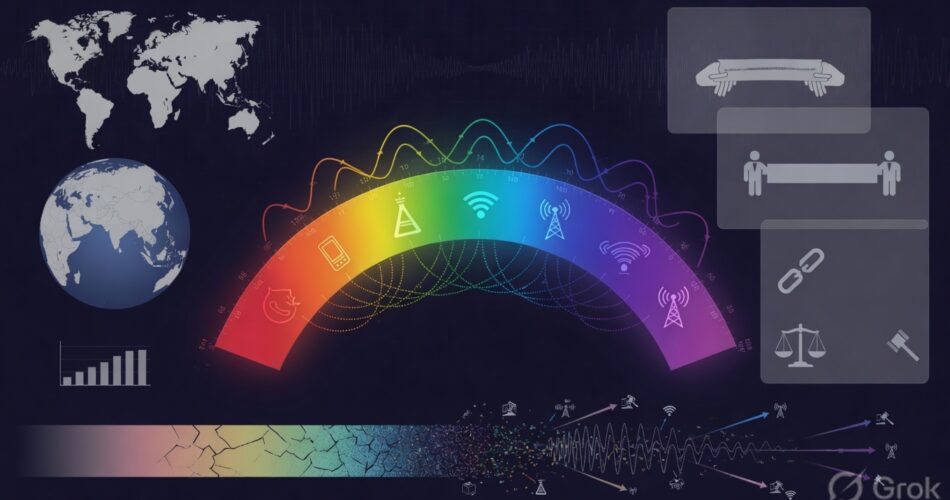
What is telecom or radio spectrum? The Supreme Court of India in its recent judgment of State Bank of India v. Union of India & Others, 2026 SCC OnLine SC 202, beautifully explained the same. To begin with, Para 13 of the judgment is quoted as under:
“13. In simple terms, spectrum may be understood as an invisible rainbow of radio waves enabling wireless services such as phone calls, television signals, Wi-Fi, and 5G internet. Physical science describes it as the electromagnetic spectrum, encompassing the full range of electromagnetic frequencies from radio waves to gamma rays. Spectrum refers to a range of radio frequencies used for wireless communications, such as mobile calls and internet services. The radio spectrum, which is a finite portion of the electromagnetic spectrum, is particularly suited for wireless communication. The electromagnetic spectrum is a finite, non-renewable resource comprising frequencies ranging from extremely low frequency (ELF) waves to gamma rays. The portion of spectrum usable for wireless communications is inherently limited due to several factors such as:
(a) propagation characteristics, as different frequencies exhibit varying propagation properties affecting their suitability for specific applications,
(b) interference, including co-channel and adjacent-channel interference, which restricts the number of users that can share the same frequency band, and
(c) technological limitations, since existing technology cannot efficiently utilise all frequencies, rendering certain bands impractical for use.”
The court further discussed that the International Telecommunication Union (ITU) has divided the world into three regions with specified frequency allocations. India falls in ITU region 3. And you would be surprised to know that the need for spectrum is only increasing and is expected to surpass 2000 MHz by 2030 for the Indian commercial sector alone.
Thus, in the words of the court, “spectrum has been internationally accepted as a scarce, finite and renewable natural resource which is susceptible to degradation in case of inefficient utilisation. It has a high economic value in the light of the demand for it on account of the tremendous growth in the telecom sector. Although it does not belong to a particular State, right of use has been granted to the States as per international norms.”
Further, since spectrum is a natural resource, the Indian government is logically and legally its trustee, and is entrusted with the duty to ensure that such natural resources are distributed in a manner best to subserve the common good in alignment with constitutional values. In this duty is also encapsulated the exclusive privilege to grant licenses for exploitation of spectrum in a reasonable manner by imposition of appropriate conditions.
The Indian government also permits trading of spectrum to enable optimal utilization and facilitate ease of doing business. In the words of the court, “spectrum trading contributes to a more economical and efficient use of frequencies. This is because a trade will only take place if the spectrum is worth more to the new user than it was to the old user, reflecting the greater economic benefit the new user expects to derive from its use. It allows the present user to decide when and to whom the spectrum authorisation will be transferred and what sum it will receive in return. The market, not the regulator, determines the value. Spectrum trading makes it possible for companies to expand more quickly than would otherwise be the case. It also makes it easier for a new market entrant to acquire spectrum in order to enter the market.”
But at the same time, the court observed that the “effective and pervasive control” over the license and spectrum vests with the licensor that is the government, and the licensee’s rights are circumscribed by regulatory oversight, disclosure obligations, restrictions on transfer, and the ever-present power of the licensor to suspend or terminate the license for breach, liquidation, or winding up of the licensee. Thus, “the ownership, particularly as a trustee of the natural resource, by the licensor, coupled with the power to suspend or terminate the licence for default in payment or performance, negates any claim of proprietary ownership in the licensee. Where the licensee has defaulted in payment of licence fees or failed to perform its obligations, the very substratum of its right to use spectrum stands impaired.” In other words, “even assuming that licensing of spectrum rights is one among the bundle of rights, in the absence of transfer of title over the spectrum, no ownership rights are created in telecom service providers either in the spectrum or in its right to use as governed by licensing conditions. Hence, under the Insolvency and Bankruptcy Code, framework, spectrum licensing rights is not a part of the pool of assets for insolvency or liquidation.”
The case actually involved the question whether ‘spectrum’ could be termed as an ‘asset’ in terms of the Insolvency and Bankruptcy Code. As evident, the court answered in the negative by observing that “merely because spectrum can be treated as an “asset” on the basis of certain attributes, such as possession and usage, lease and assignment, claim and liability or credit and debt, the entirety of the telecom sector cannot be brought under the sweep of the Insolvency and Bankruptcy Code.”
I always find judgments that deal with technology and science to be worth reading. It is interesting to see the manner in which courts interpret scientific propositions and apply them in legal parlance. To understand whether ‘spectrum’ could be termed as an asset or not, the court traced its genesis and adopted a first principles approach. One may contend that the question of spectrum being an asset has actually been left open and the court has ruled only with respect to the insolvency and bankruptcy laws. But that is the judicial limitation that always exists. Courts cannot and must not go beyond the actual legal question involved in a particular case, for the same would be akin to judicial legislation that is highly undesirable.
You can read more of my views on excessive legislation by visiting my earlier post.