
Introduction
Recently, Elon Musk posted that “humanity is disappearing” with a link to an article titled “Making Sense of America’s Low Fertility Rate.” He has been pretty vocal and consistent about this issue. The fertility rates have indeed dropped tremendously and Musk’s concerns about the slow extinction of humanity are not unfounded.
Average Fertility Rate
For a population to stay stable long-term (neither growing nor shrinking), the average fertility rate needs to be right around 2.1 children per woman. Basically, each woman may “replace” herself and her partner. But not every child survives to adulthood, and slightly more boys may be born than girls. The extra 0.1 accounts for these small losses so the next generation exactly matches the previous one.
For long-term population growth, the minimum is above 2.1 and the higher it goes above 2.1, the faster the population grows over generations (assuming no catastrophes leading to big changes in death rates).
The real question now is whether humanity will recover the lost fertility rates and reach a viable average fertility rate. Alarmingly, India, the most populous country in the world, is also suffering from the same vice. For the first time, its population replacement levels have declined and reached 1.9 from 2.3 in just a decade.
The Strategy
Asking everyone to make more babies is one of the strategies that could be deployed. In the 80s and 90s, countries like India and China were marred with misplaced policy goals relating to family planning and management. In the name of “family planning”, the governments promoted having a single child because it was thought that if the population grows too much, the “economics” of a nation might suffer. Nothing could have been farther from the truth. What is more important is not some arbitrary principles of “economics” but the actual people who make up a country or a civilization. It is a no-brainer. People will always remain more important, and the economic policies must be centered around people and not the other way around.
However, I am not even sure if the call to make more babies by governments and others is even going to work. Everybody has become too complacent and too numb towards the greater needs of humanity. Even the ones who care about humanity often end up having less than two babies because of various circumstances, be it relating to career or matrimony or something else.
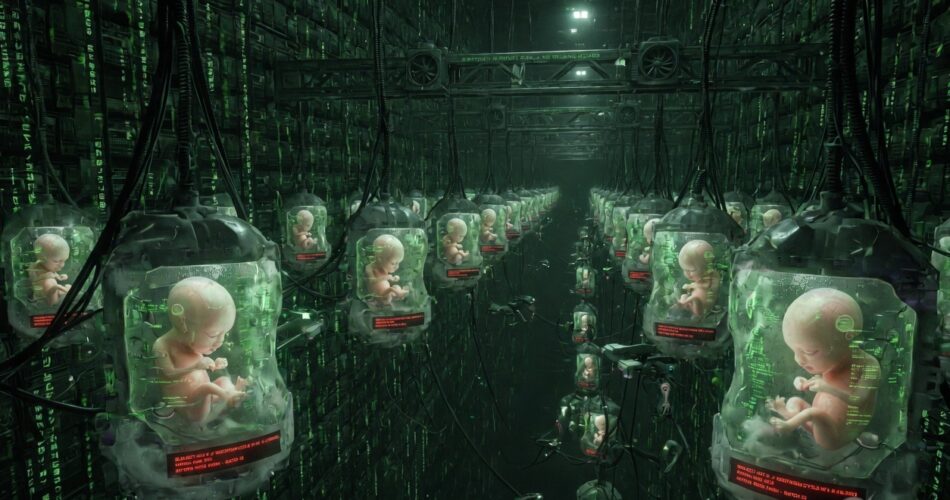
If this trend continues, humanity might reach the verge of extinction in the next few thousand years, if not less. Elon Musk is a visionary, and he has been highlighting this issue for decades. Now, the people and governments are finally beginning to see the side-effects of misplaced family planning goals. We surely do not want to end up in a Matrix-like embryonic farm dystopian world. Sadly, the trend is moving towards that.
Concluding Remarks
The irony is that everybody wants a utopia, but a collective utopia usually ends up being a dystopia. But let us not lose hope as there is still time to avoid this cosmic absurdity and achieve sustainable population replacement levels. At least, now we are beginning to realize the extent of the problem. I will end with a quote from the Hitchhiker’s Guide to the Galaxy by Douglas Adams:
“For instance, on the planet Earth, man had always assumed that he was more intelligent than dolphins because he had achieved so much—the wheel, New York, wars and so on—whilst all the dolphins had ever done was muck about in the water having a good time. But conversely, the dolphins had always believed that they were far more intelligent than man—for precisely the same reasons.”
To read more about cosmic absurdities, please click here.