
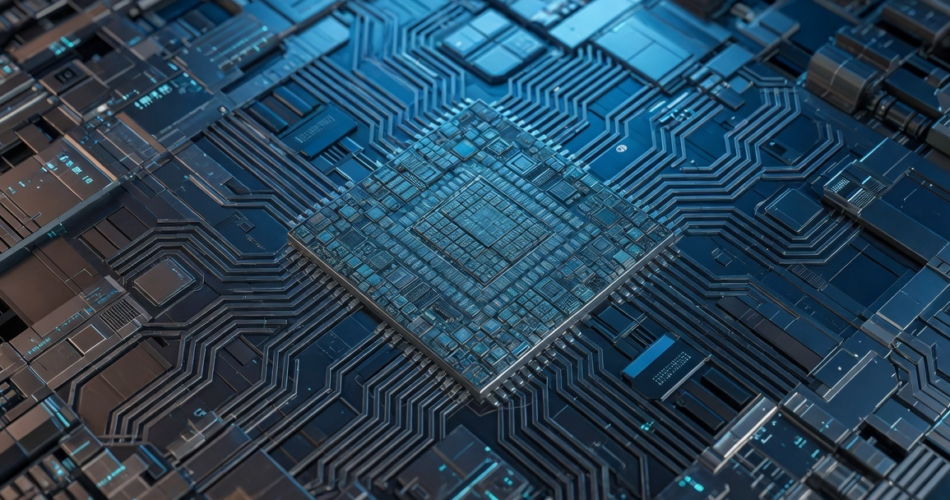
This article is a summary for non-tech noobs like me of the article “The Incredible Shrinking Transistor” published by Pushkar Ranade on X.
Modern high-end chips typically contain 150 billion to 300 billion transistors. The Nvidia Rubin chip holds the current record for the highest transistor count in a chip. It has 336 billion transistors. Your phone has around 15-40 billion transistors. But Pushkar Ranade, in his article, explains that engineers are trying to put one trillion transistors on a single chip.
Just like cells are the building blocks of life, transistors are the building blocks of computing systems. Think of a transistor like a microscopic faucet that controls the flow of electrons (electricity). When it’s “on”, electricity flows and does useful work (calculations). When it’s “off”, the flow stops completely.
The goal of the engineers is to keep making these switches and transistors smaller and smaller, so that more can be packed together and no wastage of electricity takes place. With more transistors, more complex work can be performed.
Earlier we had Moore’s Law that said that the number of transistors roughly doubled every couple of years. But Moore’s Law has hit the limit of physics now. Transistors of today are extremely small (in nanometres). But when they start becoming too small, they tend to leak electricity and become hot because wasted electricity turns into heat. The voltage (the pressure or force that pushes electrons through a conducting loop, or the push that turns the switch on) cannot be lowered after a point without losing performance.
To solve this problem, engineers changed the design of the transistor itself. They used new materials, and new ways of making them. This gave good results till the AI came into the picture. With AI, everything changed as instead of one fast general-purpose chip, now specialized chips that do massive parallel calculations are required. More transistors are being packed inside. So, again the problem of energy and heat has become massive. AI data centers already use enormous amounts of electricity. Stacking more and more transistors makes heat removal extremely difficult. Current transistors still waste too much power, especially when “off” or switching at low voltages.
To address this challenge in the AI era, engineers are trying to make new kinds of transistors that can work reliably at ultra-low voltages. Why low voltage? Because energy used is roughly proportional to voltage squared. Lower voltage means dramatically less power and heat. There are a lot of challenges here such as the transistors become weaker (they drive less current), are leakage-prone, and even the tiniest of variation in their manufacturing can lead to disastrous results. New materials such as carbon nanotubes or Germanium are being actively explored to replace Silicon. Another approach that is being explored is to use physics to make the transistors flip from off to on much more abruptly to reduce power wastage.
All these improvements and efforts go on to show that every time scaling seemed to hit a fundamental wall, engineers invented something new in the form of new materials, new shapes, new ways of stacking old stuff and so on. Pushkar Ranade and his co-author believe that the same will happen again and ultra-efficient low-voltage transistors will take us to the trillion-transistor era without making the electricity bill unsustainable. I too believe that the Jevons’ paradox stays strong.