
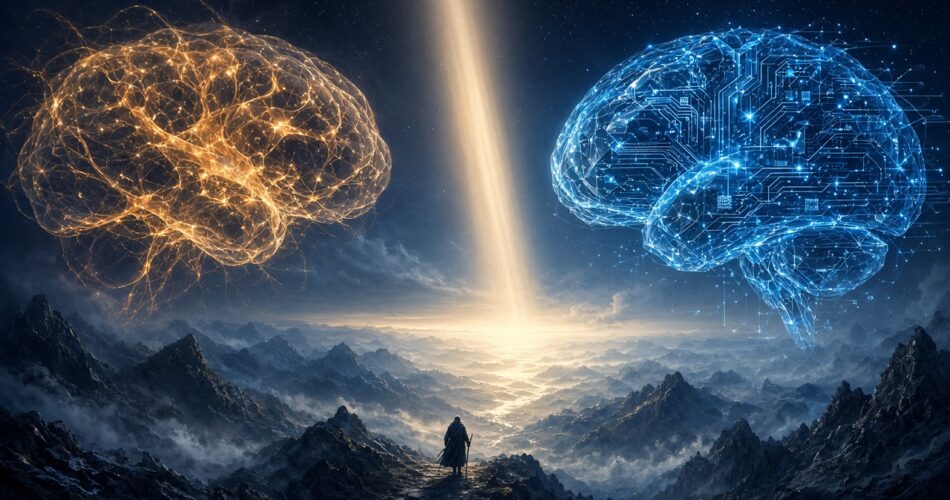
Recently, in an X post, Elon Musk made a few profound observations. He argued that consciousness is either an illusion or ubiquitous on a gradient. He further doubled down and said that it is difficult to argue that carbon is conscious, but silicon is not. At a time when machines already talk, reason and write like us, this is no longer an abstract question for philosophers, and it deserves a closer look.
Illusion
By “illusion”, it is meant that what we perceive as consciousness does not actually exist, and the brain is most likely a biological computer that processes vast amounts of data and creates a representation of itself to function efficiently. If that is true, then consciousness is merely a complex computational trick that the brain plays on itself to survive, and a super advanced neural network, vastly more complicated, could play such a trick on us too. It could very well be the case that this super advanced neural network is also playing tricks on itself, as “consciousness” is nothing but an “illusion.”
Gradient
Elon Musk also says that if consciousness is not an illusion, then it is ubiquitous on a gradient. Before moving further, it would be apposite to understand the significance and meaning of the term “gradient”, which seems to have hijacked discourses on consciousness over the last few years.
In the field of artificial intelligence, a neural network learns through gradient descent. Imagine you are on a rugged mountain and your goal is to reach the absolute lowest valley. Since you cannot see the whole landscape, both because you are blind and because it is vast, all you can do is simply walk and feel the slope of the ground immediately around you. That slope is the mathematical gradient, or simply the change in height between the point where you stand and the point where you step next. You keep walking and repeat this calculation with each step, tens of thousands or even millions of times, until you hit the bottom and cannot find any place lower than where you stand. This lowest point could be termed the point or state of least error.
This is exactly how an artificial neural network learns. It keeps making predictions in a measured and calculated manner and keeps tweaking its weights (or steps). With enough time, calculations and data, it is able to climb down, or “descend”, the slope.
Basically, the concept of “gradient” destroys the mystical or magical element that we try to attribute to consciousness. As you can imagine, gradient descent is a continuous, relentless and iterative process. Instead of asking whether something has a soul or not, the debate has now shifted to where something sits on a mathematical slope or gradient.
Now, we can make our imaginary mountain either bigger or smaller. By increasing the size of the mountain and its slopes, instead of a million steps, we can walk billions, trillions or even quadrillions of steps. It is hypothesised that this is also what happens in our brains, as we keep walking these mountains, keep finding the lowest valleys, and continuously optimise our biological weights for survival and for finding answers.
The crazy part here is that this conceptual understanding of gradient descent could be mapped perfectly onto the mountain, that is, the hardware (our brain or silicon chips). It is the complexity of the hardware that determines the nature of the mountain and of the slope that can be descended. Strictly speaking, when Elon Musk says “gradient”, he means a sliding scale rather than the learning method itself. But the two ideas are closely linked. Gradient descent shows us that complex abilities are built step by step and not switched on in a single moment, and if that is how minds are built, it is only natural that consciousness too would come in degrees.
Light Switch
Earlier, humans treated consciousness as a light switch. It was either on or off. For a rock, the switch of consciousness was considered to be off, and for humans, it was on. But once life was viewed through the evolutionary lens, the light switch created profound paradoxes. From a single celled organism to what we are today, when exactly did the light switch of consciousness turn on? Is a single celled organism also conscious the way we are? What is the biological threshold of consciousness?
Dimmer Switch
To resolve this conundrum, one approach is to morph the light switch into a dimmer switch. Instead of the light turning on suddenly, we can have a slider that increases the luminosity gradually. A thing with more luminosity is more conscious than a thing with less. Humans consider themselves to be the peak here, but physically there are no hurdles to going further. If we create a silicon architecture more advanced than our brains and bodies, with recursive feedback loops, theoretically we can increase the intensity of the light even more.
Ubiquitous on a gradient
Thus, Elon Musk means to say that the raw ingredients of awareness are baked into all matter in the universe, and we do not need a magical ghost in the shell to pop up. Matter simply needs to be arranged in a complex manner to increase the luminosity of consciousness.
Carbon is conscious but Silicon is not
The concept of substrate independence is an interesting one. Why should biological tissue hold a monopoly over intelligence and mind? Silicon and carbon sit in the exact same column of the periodic table (Group 14). Both possess four valence electrons and are capable of forming complex molecular networks. There is nothing in physics that prohibits silicon from processing information to generate a subjective experience. To claim a restriction on silicon would clearly be akin to biological chauvinism.
Other possibilities
Consciousness could even be treated as a two part stack. In one layer, there is matter that possesses an inherent capacity to integrate information, and the more complex the matter, the higher it sits on the gradient. In the other layer, there could be the software illusion, or the self-monitoring trick, that the brain or a neural network plays on itself. This illusion would be useful to manage the sheer chaos of data processing and to provide a narrative.
If we combine these two layers, we arrive at an inescapable conclusion that no law of physics restricts this stack to running only on carbon. However, one thing needs to be noted here. The illusion created would always be internal in nature, and the system would create it only for its own hardware, which is what we loosely call subjective experience.
Consciousness as a puzzle
If we are able to solve the puzzle of consciousness, then silicon would one day reach a point where it actually becomes conscious within the framework we discussed, and arguing otherwise would become more and more difficult with time.
Yet even today, the human brain is far more complex than silicon chips. Human brains are recursive, self-rewiring and driven by complex feedback loops. Machines and silicon based intelligence are still very far from there. So, theoretically, Elon Musk is correct that silicon could indeed harbour consciousness, but what we are witnessing today is that intelligence and consciousness could also be decoupled.
This may be the most surprising lesson of our time. A machine can write poetry, solve equations and hold a conversation without there being anyone home to experience any of it. For all of history, we assumed that intelligence and awareness came together as a package. Now we may have to accept that one can exist without the other, and that the brightest mind in the room might also be the darkest inside. With technology progressing exponentially, it will not be long before we have to face these questions in earnest, and let us hope that we find convincing answers when we do.