
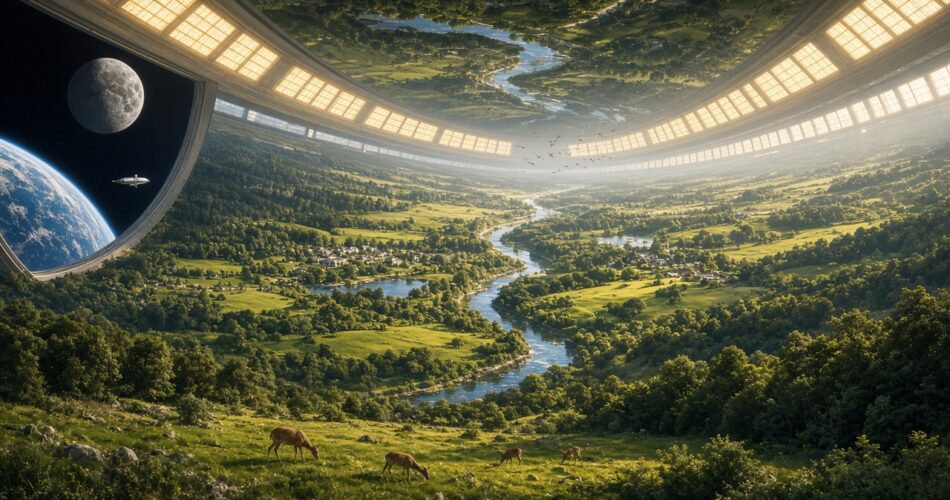
We keep hearing that space is the final frontier. The recent successful launch of Ship 42 on Starship’s fifteenth flight brings us one step closer to exploring humanity’s great unexplored territory.
Fermat’s Library on X recently shared a fascinating 1974 paper on the colonization of space by Gerard K. O’Neill, a famous American physicist at Princeton. O’Neill argued that the main barrier to space colonization is not technology or physics, but the high cost of lifting mass from Earth. This is exactly the problem that Starship is solving. Compared to the earlier NASA era, Falcon 9 has already brought down the cost of lifting mass substantially. Starship is going a step further and will bring that cost down by several orders of magnitude.
The Idea
Once the cost of taking material to space drops substantially, not only will celestial bodies like the Moon and Mars be colonized, but artificial habitats like the one proposed by O’Neill will also get built. In his paper, O’Neill observes that colonizing space does not require robbing the Earth of its resources, since the building materials can come from places like the Moon and the asteroids. He argues that planets are the wrong place for large long term populations, and that free space is better because it offers:
- Continuous full-time solar energy
- Easy access to materials from the Moon and asteroids
- Artificial gravity via rotation
- No deep gravity well making shipping expensive
According to O’Neill, the best habitat design is a pair of counter-rotating cylinders (about 4 miles in diameter and 16 miles long), inside which there can be Earth-like valleys with grass, trees, lakes, rivers, parks, animals, and birds. Agriculture could be carried on in separate areas. Some of the other proposed features are:
- Alternating strips of land (valleys) and windows (solars).
- Rotation of about two minutes per turn for the large size, so people feel normal Earth gravity on the inner surface.
- Large mirrors outside that bring in natural sunlight and create day and night cycles by opening and closing.
- An Earth-like atmosphere and pressure, the same as at sea level.
- A structure using steel cables as a conservative choice, though aluminium and titanium from the Moon would be preferred in practice. Windows could be made of glass or plastic in small panels, and the cables in the window areas would be nearly invisible.
What strikes me most is that none of this needs new physics. Spinning a cylinder for gravity, using mirrors for sunlight, and building with metal and glass are all things we already understand. The only thing that was missing was a cheap way to get there, and that is precisely what has changed in the last few years.
What Changed
When the paper was written in 1974, there were hardly any technologies that could support the ideas it espoused. Today, however, in the age of Starship and superintelligence, it is becoming increasingly clear that the colonization of space will soon become a reality. Initially, we will have to build colonies on the Moon or Mars, so that we position ourselves appropriately to harness their resources. Once that happens, the long term game is bound to be what O’Neill proposed.
In his detailed paper, he highlighted that almost all the material could initially come from the Moon and be launched by a mass driver (an electromagnetic catapult). The economics would work out too, because the excess solar power the colonies harness could be beamed back to Earth or used to build more colonies. Lastly, he noted that living conditions in such artificial habitats would be as good as or better than Earth’s, as there would be clean, unlimited solar energy and pollutants could be fully recycled.
I find the idea of rotating cylindrical habitats a visionary one. It is truly amazing that O’Neill could think of it as early as 1974. This kind of big picture thinking inspires humanity and gives birth to more ideas.
O’Neill had the vision but not the tools. Today, with cheap rockets on one side and artificial intelligence on the other, we are finally beginning to have both. We are living in the singularity, and let us hope that on the other end of it, we find autonomy and abundance. It is also our responsibility to ensure that man-made crises do not take over and derail us from the possibility of a prosperous future.