
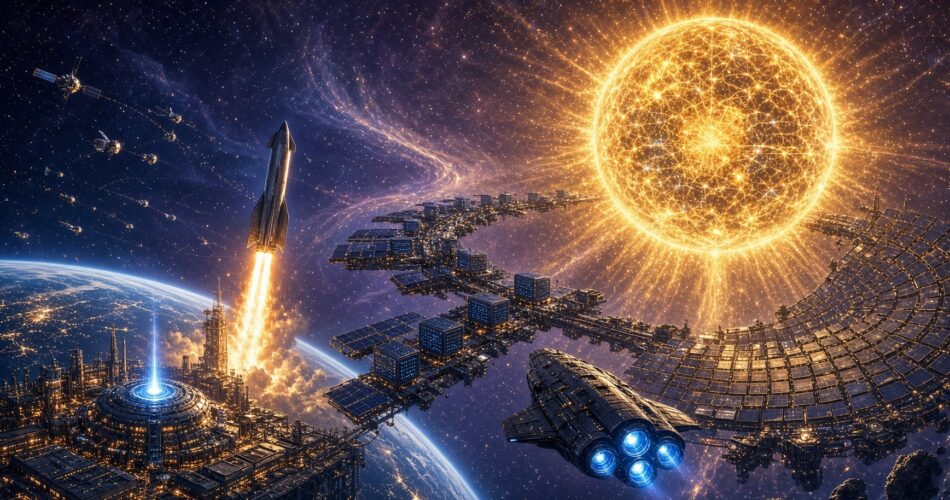
Elon Musk has said categorically that tonnage and wattage will be the only true currencies of the future. He also states that “it could be that the purpose of humanity is to give birth to a star mind, a sentient sun.” These two statements are quite connected to each other.
Making Orbital Computing Real
To understand, it is pertinent to note that all efforts are being made today to make orbital computing a reality. Starcloud has already demonstrated that GPUs could successfully operate in space, and that data from the compute done by the GPUs in space could be transferred back to the Earth. Starship is also on its way to achieve rapid reusability in the near future. Once that happens, the two most valuable commodities from the perspective of accelerating our civilization and becoming Kardashev 2 would be semiconductor chips and solar panels.
The Semiconductor Bottleneck
Semiconductor chips are the highways on which intelligent electrons traverse and solve complex problems. Without high-end chips, it is impossible to scale the compute. Today, for manufacturing these chips, there are many bottlenecks. The fabs such as TSMC are already working overtime, and lithography companies like ASML also suffer from the same fate. In fact, there is still no reputable chip foundry in the USA that can do end-to-end manufacturing of semiconductor chips at the required scale today. The answer to this problem is Terafab, which will be a gigantic 100-million-square-foot enterprise, even having a free-electron laser (FEL) at its centre to produce chips from scratch at an unprecedented scale, around 1 terawatt of compute every year once Terafab becomes fully functional.
Energy Beyond Earth
But these chips also require energy to run, in the form of electricity. Electricity is limited on Earth, and even with all the solar panels that we can install, the scaling can max out only so much. Whereas there are distinct advantages of having solar panels in space. They not only have better efficiency in space due to no atmosphere, but the real estate in space for solar panels is also virtually unlimited. Other problems in space with respect to computing, such as cooling and regulatory issues, are also virtually non-existent. Space is cold anyway, and with basic radiators, the GPUs in space can operate without requiring conventional water-based cooling, thereby completely eliminating the need for water and excess energy to support water or other forms of cooling.
What Tonnage and Wattage Mean?
This is exactly what Elon Musk means by tonnage: the tonnage of semiconductor chips and solar panels into space. Only that will matter, and nothing else. Our capacity to deploy more tonnage into space will translate into more compute. Similarly, wattage too has a distinct but connected connotation. The solar panels are to be taken to space to harness the energy of the Sun, and eventually create a Starmind. The more the solar panels, the more the energy (wattage). Thus, neither semiconductor chips nor solar panels alone can solve the problem of taking us closer to Kardashev 2. We need both, and we need both in space.
Constraints
Having semiconductors and solar panels on Earth will eventually hit a limit, because there is only so much area on Earth that could be covered with solar panels, whereas in space the area is virtually unlimited in comparison. The only bottleneck is how much cargo can be carried to space and how much energy and compute that cargo is actually capable of generating.
There cannot be any other future that makes sense for humanity. If for a moment we consider that orbital compute is just sci-fi and a more grounded future would be to build and utilize whatever we have here on Earth, it sounds good on paper, but in reality we are already on the verge of hitting hard limits in many areas. Even if we give up our space dreams and start focusing on increasing compute and energy infrastructure on Earth, we will be hitting a wall at most in a few decades, and then, since the resources would be finite, there would be petty power struggles, blame games if things fail, or the tendency to sabotage the progress of others simply out of spite or jealousy.
This in no way means that the transition of the future to one where only tonnage and wattage matter is going to be smooth. Solving hard problems of physics is harder than tackling the Earth’s politics. But such a path would ensure long-term viability and would align with an optimistic future where humans can think of going Kardashev 2.