
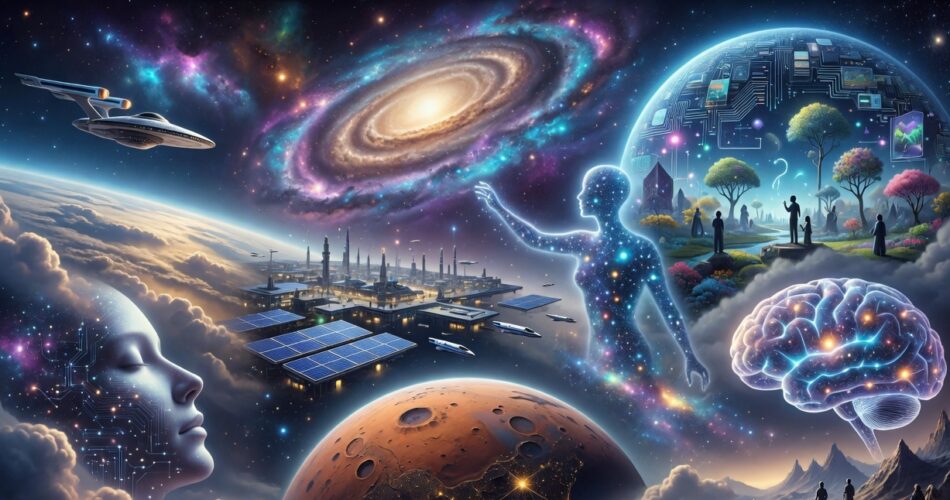
A mix of Star Trek and Ready Player One will be one of the best things that could happen to humanity. If we could make habitable both the space and the virtual world inside circuits, there will be no layer of reality that would not be harnessed by the humans. It is sci-fi for now, but AI is progressing at a frantic pace.
Limitations of Earth
Exponential growth is real and the cost of computing is going down all the time. The rate of acceleration is only going to increase because humans are planning to have orbital data centers in space. Earth has its own limitations. We do not get as much sunlight as it is possible to get in space, and there are various political issues such as water crisis, regulatory mechanisms etc. that impede the rate of installation of data centers.
It is true that installing data centers is easier said than done and though Starcloud has successfully demonstrated that GPUs could run in space (Nvidia’s H100), that proof of concept does not automatically translate into scalable infrastructure. Top space companies like SpaceX are already working on solving this problem of scalability. The biggest hope in this regard is the Starship. Once Starship achieves rapid reusability, it will be able to cargo solar panels and GPUs into space at unprecedented levels.
Power & Compute
All this is necessary because at its core, AI is nothing but a human effort to expand intelligence and its contours. The human brain is a piece of marvel and there is no other intelligence as efficient as humans’. Despite that it has its limitations. To solve certain problems, even the collective brain power is not enough. If we want to truly turn our sci-fi imaginations into reality, and convert all theoretical physics into practical ones, we need both tremendous amounts of compute and power. In an earlier article, I had discussed that “our brain is doing massive amounts of compute on the order of 10^16 calculations per second (cps).” It may seem a lot and it actually is, but to solve cosmic mysteries or to find the answer to the question of life, we need way more such as on the scale of 10^26 cps or above where our brain stops being the reference frame and focus shifts to designing high fidelity planetary models and beyond.
The point that I am trying to make is that eventually, humans will become one with the AI in the future. There are several paths to it and all of them seem to converge. There is the Neuralink path, where zero latency communication between brain and machines becomes possible, there is the creation of Von Neumann probes that can take the shape of anything, there is the setting up of a new civilization on Mars, and the using of all these achievements to reach Kardashev 2. The path to Kardashev 2 requires AI and space. Thus, it will not be a folly to say that the next evolution of humanity will be written in space.
The Road Ahead
Will we still remain humans after achieving so much progress? The answer is both yes and no. A part of us will still remain, but almost all of the present-day needs will be replaced with other forms of hopefully higher needs. What those exactly will be is hard to fathom at this stage, and that is the reason why everybody is saying that we are in the Singularity. What lies on the other side of the Singularity is precisely what nobody knows.
Actually, the path to Kardashev 2 is now pretty much a fait accompli unless humans destroy each other in some world war or something. It so happens that every few weeks, new breakthroughs are being made in the field of AI and elsewhere. In fact, AI is accelerating breakthroughs in all other fields as well. Some kind of hyper-acceleration is going on where the future of humanity is being fast forwarded beyond our wildest imaginations.
There are still doomers in the society and even in the age of abundance that is about to be unlocked, we will have these doomers, although their numbers are sure to dwindle. There is a lot of hope and let us focus on that.