
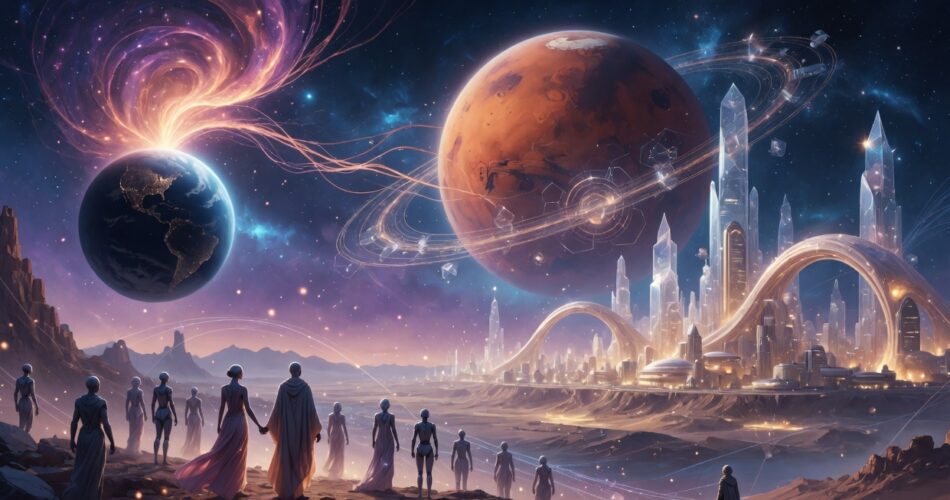
The dangers of Earth being transmitted to Mars like a contagion are real. I have talked previously about the need for debating the future Constitution of Mars. We need to think about it now because Mars has not been colonized yet. Once it gets colonized, it will be too late.
Mars v. Moon
Before moving further, a distinction between Mars and the Moon needs to be made. Mars is farther from Earth than the Sun is, around 225 million km, whereas the Moon is less than 400,000 km far from Earth. It is a satellite of Earth and revolves around it. In a way, Moon and Earth are two sides of the same coin. Whatever happens on Earth will quite likely be extended on the Moon as well. Also, we need the Moon to work in sync with Earth, in a way that a civilization on the Moon cannot remain oblivious to what happens on Earth. The distance and inter-dependence are too real and close. We should understand this extreme interdependence by the fact that the tides on the ocean of the Earth are generated due to the Moon’s gravitational pull.
Thus, it is neither possible nor desirable to have any segregation of the Moon with Earth in any manner whatsoever. Here we also need to acknowledge that the concept of sovereignty of nation-states is very likely to be extended to the Moon. It is not a perfect scenario but having two distinct systems of governance on the Moon and Earth would create long-term friction and conflict of interest. The Moon must be conceded to the political climate and situations of Earth.
However, the same is not the situation with Mars. Mars is extremely far away from Earth, so far that it would take months to do even a one-way trip. If we draw some historical parallels, today going from Earth to Mars is like going from India to America or Australia a thousand years ago. The journey was perilous and took months, if not years. Due to vast physical distances, it was not possible to extend the concepts of sovereignty on far-flung places. The same would be the situation with Mars.
For the near foreseeable future, unless we develop some exotic space travel tech, the society on Mars will have to be formed with a clean slate. Even if we have AI like Optimus that goes to Mars and sets up habitable conditions for human arrival, then also, it would be a folly to expect that people on Earth could control the Martian society like puppeteers. Martian society will have its own independent existence, whether we like it or not.
When people would start going to Mars initially, there might be some level of subservience or indebtedness that they might feel to the people on Earth, but after a few decades, once the society of Mars actually starts shaping on its own, once the first human being is born on Mars, the situation would change drastically. The people actually born on Mars might feel that even though we come from Earth, we have our own independent existence and problems here. Why should we be governed from 225 million km away and why can’t we have freedom in the true sense of the term? These would be some very pertinent questions.
The role of Earth should be like a friend. We should act like prepared progenitors who anticipate the needs of the future Martians with a reasonable degree of certainty. If we fail to do so, we will not be able to shape the future and contribute to it in any meaningful manner. Also, if we anticipate the needs of future Martians correctly, we will be accelerating their growth and development. Anyways, with the help of AI, the Martians would be as smart as Earthlings, if not smarter.
Future Prospects
There is another fear as well. If we are not prepared for the future Martian society, we might end up harming its interests and eventually jeopardize our core mission of expanding the horizons of consciousness. The future on Mars should be full of hope and not despair. Of course, there will be dangers and hardships, but the long-term vision should be clear, which is to become a Kardashev 2 civilization.
Ultimately, in the very long run, there will be fusion of Martian and Earth society, but till we meaningfully come close to Kardashev 2, we must give space to the Martian civilization and let them grow at their own pace, and the standards applicable on Earth must not be forcefully imposed on Mars. This is also desirable from the perspective of making life multiplanetary. If something bad happens on Earth, Mars will act as a backup planet for humanity. As I said, these problems will be pertinent only before Kardashev 2. After Kardashev 2, the entire solar system will likely become one civilization. There are cogent reasons for thinking so.
A civilization that could harness the energy of the Sun in a meaningful manner will have a tremendous energy budget, so much so that it will even be able to restore the atmosphere on Mars using exotic techniques involving toroidal magnetism. Mars also might prove to be very much Earth-like once it gets a habitat. My point is that the dangers of civilization on Earth must not be transmitted to Mars. It would be a fatal mistake and we would be risking all for nothing.
Futility of International Law
I am not a big fan of International Law. In the age of blockchain and AI, there are ample ways to do decision making in a distributed and decentralized manner. Earlier it was not the case. Everyone could not assemble at one place and that gave rise to the idea of a legislature where few could make laws on behalf of everyone. Such a system was never perfect because even the elected representatives were elected by a majority of the voters, mind you, majority of the voters or electorate does not mean majority of the entire population. Today, we do not need such archaic super-simplification. With the help of latest technologies, we can know the views of each and every citizen of Earth or on Mars within seconds, and such data can also be processed in a transparent manner in real time.
In that scenario, I sincerely think that the time has come to give a re-think about the entire structure of governance that is being followed on Earth. The countries are vague representatives of their citizens now. The citizens have nuanced needs, and we have the tech to understand and take cognizance of those nuanced needs. That is one of the biggest dangers that may be transferred to Mars. It will be very difficult and slow to transform the hegemony of nation-states on Earth into something better. But Mars can start with a clean slate and this latest tech could be used there to come up with a starkly different model of governance, where people actually become the government and there is no separate government per se. The whole concept of taxation as we have on Earth can be done away with.
Today, governments are woolly mammoths that are slow and energy-intensive. If a government becomes lean and agile, and principles of design thinking are applied on governments using latest technologies, the situation will become very different. It is high time that philosophers, technologists and visionaries of the present day world unite and start thinking about these issues. There will be a lot of resistance. Naysayers will demotivate and contend that such ideas look good on paper but cannot be implemented in reality and we do need governments for our protection. I think we can conveniently ignore those arguments for now and at least start deliberating about the new ideas that are possible today.