
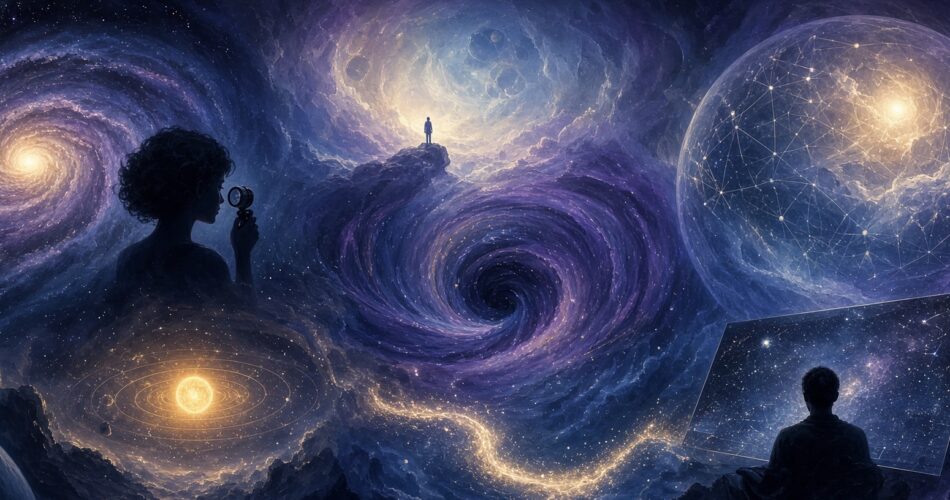
Nobody knows what dark matter actually is, but the public expectation about scientists cracking the mysteries of dark matter is immense. I, too, do not understand what it is, yet it seems that scientists have a fair idea about what dark matter is not. The crazy thing is that there is something that holds the galaxies together and responds to gravitational force, but it neither emits nor absorbs light in any manner, to the best of our knowledge.
The Dark Mystery
At this juncture, reference ought to be made to Vera Cooper Rubin (1928-2016), who showed us that galaxies do not spin the way visible matter says they should. To appreciate the significance of her work, let us talk about the solar system, the entire mass of which (99.86%) sits in the Sun. The time taken by planets to revolve around the Sun increases with their distance from the Sun, as the gravitational pull becomes weaker with distance. Astronomers thought that galaxies should also work the same way. Usually, there are supermassive black holes in the middle of the galaxy, and the stars move around the centre. So, the stars that are farther from the centre of the galaxy should be moving slower than the stars that are near the supermassive black holes. However, upon observation, Vera Rubin found out that it is not the case, and the stars that are at the border of the galaxy are racing as fast as the stars that are near the centre. This clearly meant that there is something invisible that is adding the extra gravity, and this invisible thing is most likely wrapped around the galaxy. What this invisible thing actually is, nobody knows, and that is the reason it is called dark matter.
The Simulation Hypothesis
That unknown is still being hunted. Recently, at the Sanford Underground Research Facility (SURF) in Lead, South Dakota, USA, where a dark matter experiment is being conducted, it was reported that scientists saw one odd signal that could have been a dark-matter particle, but it is far more likely just leftover noise, not the real thing. This has again led people to discuss that maybe there is no missing particle, or maybe we don’t understand gravity itself in a proper manner. Elon Musk also posted on X and called dark matter “an error in the simulation.”
To understand what Elon is trying to say, we need to connect the dots and understand the simulation hypothesis first. In simple terms, it is the idea that the world we live in is not the “base reality.” For example, when you play a video game, the video game is running inside the computer, and that computer is physically existing in our world. So, we know that the video game is definitely not the base reality because it exists inside a computer. Similarly, the world in which we live may not be the base reality either, meaning our world might also be running inside a computer. Now, that computer has to be very big and powerful, but nevertheless, it could be a computer, and our reality is so well made or rendered that it becomes impossible for us to tell whether we are inside a computer or are in the base reality.
Nick Bostrom, a famous author and a philosopher, postulates that there are three choices and at least one of them must be true:
- Almost no civilization goes far enough to become capable of creating realities like ours.
- There may be advanced civilizations that have the power to create realities like ours but are too lazy to actually create creatures like us.
- We are inside a computer and are a simulation.
Elon’s case is that if we look at the progress of computing, we started with barely 2D games, and today we have video games that are becoming increasingly indistinguishable from our own reality. If we can achieve so much in a few decades of progress, advanced civilizations could achieve much more in a bigger timeframe. Thus, it is highly unlikely that our own reality is the original one. There is no proof for this, maybe there never will be, and that is the reason it is called a hypothesis.
The Mystery Continues
Coming to dark matter, if we are indeed inside a simulation, then dark matter could either be a bug or a feature of this simulation. The fact that we have not been able to decipher it so far points out that either it is a code that was never rendered for us to see, or there is still more to it. If it is a code that we are not allowed to see to understand, then for us, dark matter is very well an error or a bug, because it is meaningless for us. We do not know what the truth is, but this is certainly a very interesting possibility.
Dark matter and dark energy continue to elude us and remain the greatest mystery of our universe. Most of the universe seems to be made up of them, but we have no clue about what they are. Hopefully, with advancements in AI, we will have better computing power at our disposal, and that might help us understand what it is or is not in the future. The simulation hypothesis makes sense, but to prove it we will have to break our reality and enter the reality above us that is rendering us. Life does feel like a video game at times. What are your thoughts?