
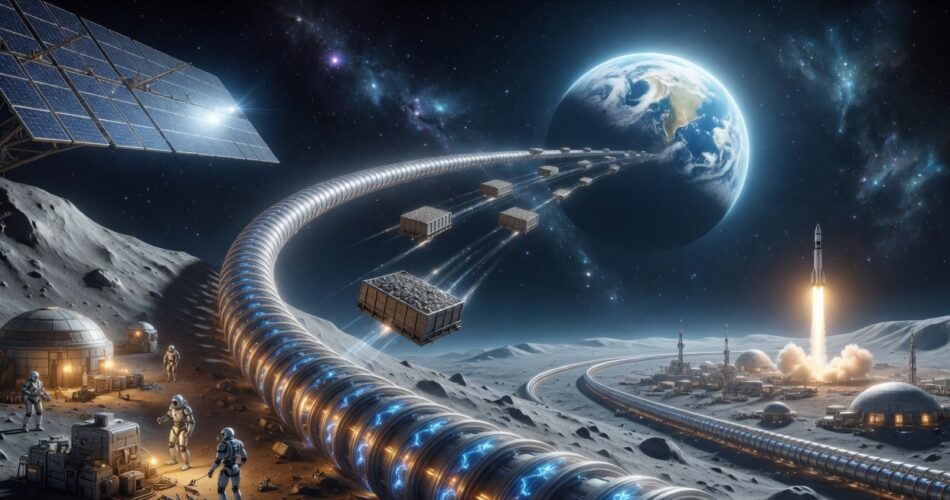
In the book, The Moon Is a Harsh Mistress, by Robert A. Heinlein, there was a lunar colony that uses a large electromagnetic catapult to launch cargo containers of grain from the Moon to Earth, and later on, the same catapult is turned into a weapon by throwing huge boulders at Earth.
What are Mass Drivers?
Mass drivers are a fascinating concept that have been in the realm of sci-fi for a long time. Essentially, they are devices that can accelerate payloads to high speeds using only electromagnetic forces, without rockets or chemical propellants. You can think of them as giant slingshots that throw things into space. The Moon is a perfect place to have them because it has much weaker gravity in comparison to Earth making it easier to throw things up. Also, the Moon has no air or atmosphere, so nothing slows down the speed.
Historically, many prototypes of mass drivers have been made. One of the most important works in this regard is that of Gerard K. O’Neill and Henry Kolm at MIT who made mass drivers that were able to achieve accelerations of up to 500 g. Many universities and institutes have made designs relating to mass drivers but since the chemical rockets improved faster than expected, the idea took a backseat. However, recent interest has been shown by SpaceX, NASA etc. to harness this concept on the Moon due to obvious reasons.
Renewed Interest
Recently, Jared Isaacman appeared on the podcast, Moonshots by Peter H. Diamandis, where he discussed the key objectives that NASA is trying to achieve. Interestingly, one of the main objectives of NASA in the near future is to get Americans back to the Moon and build a permanent base. He also discussed mass drivers on the Moon.
Imagine humanoid robots mining lunar materials, processing them and launching them toward Earth using a mass driver powered by solar or nuclear energy. This would dramatically lower the cost of moving mass off the Moon. The best part about mass drivers is that no onboard propellant is needed for the acceleration phase as the energy comes from an external power source. Once it reaches the desired velocity, it is released and continues on a ballistic trajectory in space because there is almost nothing to stop it. Even the gravity of the Moon will only change the direction of the path (making it curved) and does not cancel out the forward speed the mass driver had already given to the payload.
Advantages
Mass drivers have a significant advantage over chemical rockets. There is no combustion, no high-temperature engines and fewer parts that need replacements for each launch. The saying that one century’s magic is another century’s science is indeed coming true. Who could have thought that humans will plan to build ultra-large catapults to throw things in space from the surface of the Moon? If the idea is successful, the mass drivers also might help their competitors, the rockets, too. A mass driver can accelerate rockets along a track to high speed before the rocket engines ignite. This way, the rocket starts with a base velocity and would require less fuel to reach orbit. Eventually, this might also help in making smaller, lighter and cheaper rockets. The whole idea that rockets must carry their own fuel will also be revisited in this process.
Thus, rockets along with mass drivers can lead to the creation of a viable space economy in the future where transferring payload becomes exponentially cheaper and a positive feedback loop gets created where there are cheap materials leading to more construction leading to higher demand leading to bigger mass drivers eventually leading to even cheaper costs of material.