
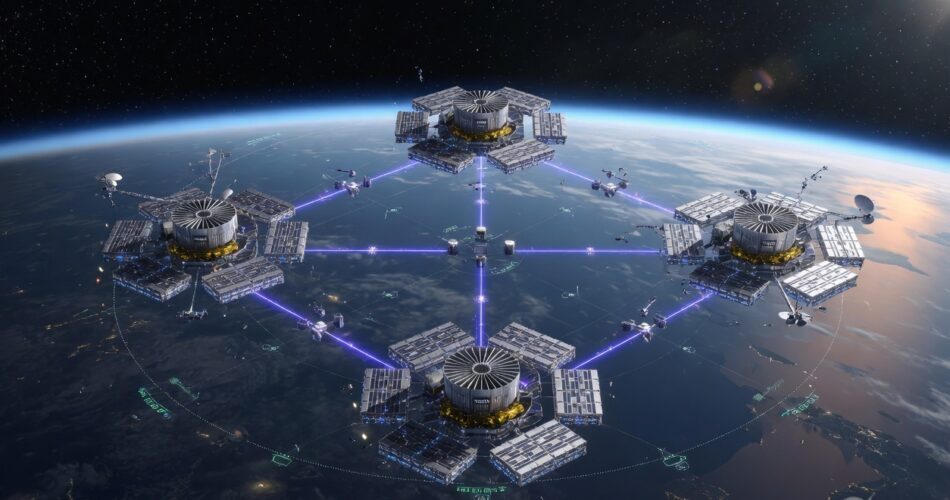
In February 2026, the Federal Communications Commission (FCC) accepted SpaceX’s filing seeking authority for an Orbital Data Centre System consisting of up to one million satellites operating at altitudes between 500 km and 2,000 km. The system will primarily rely on optical inter-satellite links, which may connect with other satellites in the proposed system as well as with satellites in SpaceX’s first- and second-generation Starlink constellations. The stated purpose is ambitious, to represent the first step towards becoming a Kardashev II-level civilisation, one that can harness the Sun’s full power.
While SpaceX is pushing the boundaries through sheer scale, another company is already showing what orbital AI compute can look like in practice. Starcloud launched Starcloud-1 carrying the first NVIDIA H100 GPU into orbit. This was a landmark achievement, as it successfully demonstrated real AI workloads in space, including training a small LLM (nanoGPT by Andrej Karpathy) and running a version of Google Gemini in orbit. Starcloud has since filed its own application with the FCC for a distributed orbital AI compute system, proposing up to 88,000 satellites.
The connection between the two companies has grown stronger. In May 2026, Starcloud entered into a strategic relationship with SpaceX. The company plans to launch its future satellites, beginning with Starcloud-2, aboard SpaceX Falcon 9 rockets. This creates a symbiotic arrangement in which Starcloud leverages SpaceX’s launch capability and communications infrastructure while contributing actual compute capacity in orbit.
Although SpaceX remains the dominant player in this emerging domain, Starcloud could play several important roles such as:
- Technology validator: Having already proven that high-performance GPUs and AI workloads can operate effectively in space, Starcloud helps de-risk the broader sector.
- Complementary ecosystem player: By using Starlink as its data backhaul, Starcloud strengthens SpaceX’s overall space infrastructure.
- Regulatory pathbreaker: Its filing, alongside those of SpaceX and Blue Origin, is compelling the FCC to develop a regulatory framework for the emerging field of “Orbital Data Centres.”
- Specialised compute provider: Starcloud could focus on high-value applications such as edge AI and sovereign compute, rather than directly competing with SpaceX on scale.
All in all, this is extremely positive news coming from the space sector and provides tremendous hope for humanity. Humans have developed extraordinary technological and scientific capabilities, and if these are not harnessed for constructive purposes such as expanding the horizons of consciousness into space, there is a real likelihood that we will end up using this technology to fight mindless wars with each other. By widening the scope of civilisation into space through orbital data centres, we are laying the concrete foundations of a Kardashev Type II civilisation. The more we harness the power of the Sun, the better off we will be in the long run, and the greater our chances of moving beyond the stagnant bureaucratic culture that has taken root on Earth.
Ad astra per aspera!