
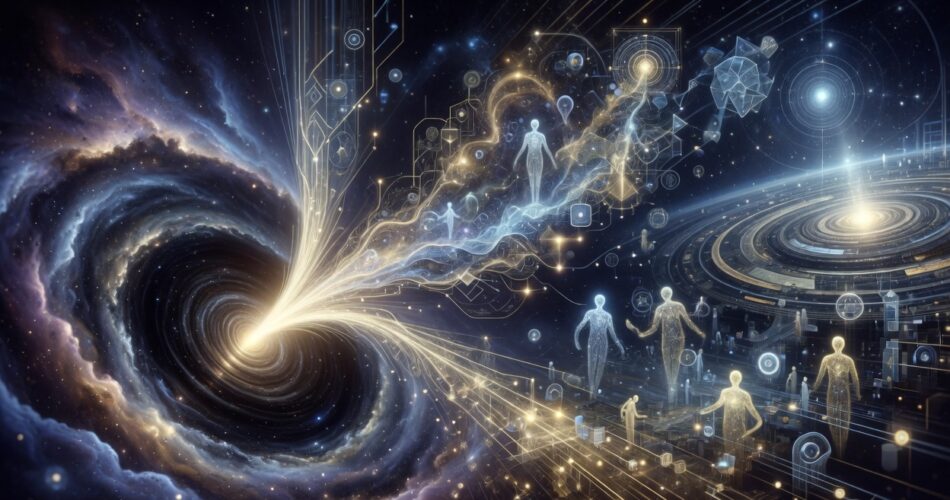
One thing which is being told increasingly these days is that we are living in the Singularity. Let us understand what it actually means. Ray Kurzweil in his book The Singularity Is Near explains it as “an English word meaning a unique event with, well, singular implications.” He further explains that the Singularity “represents the nearly vertical phase of exponential growth that occurs when the rate is so extreme that the technology appears to be expanding at infinite speed.”
He has laid down many principles involving the Singularity such as the accelerated rate of technological innovation, non-biological intelligence, and saturation of matter and energy with human-machine intelligence etc. The word “Singularity” is also used in astrophysics to denote a black hole from which light was thought to be unable to escape. His point is that we cannot “look past the event horizon of the Singularity and make complete sense of what lies beyond. This is one reason we call this transformation the Singularity.”
So, are we really in the Singularity? There is a great chance that we are. I have the following reasons to supplement this assertion:
- Intelligence is independent of biology and is computable – Any process that transforms information according to rules (thinking, planning, discovery) can, in principle, run on silicon as well as neurons. Once we build the right hardware, there is no fundamental barrier to achieving or surpassing biological intelligence.
- Recursive self-improvement (RSI) is already beginning to happen – The AIs of today are beginning to show glimpses of making themselves better. They do need some form of human in the loop right now, but through agentic AI, the AIs are able to talk to each other and outperform their past versions by orders of magnitude. Unhinged RSI is still not there, but the gap is closing faster than expected.
- Scaling laws are real – More energy, more compute and more data is not an assumption. It is increasing by orders of magnitude. Better chips and algorithms are happening too.
- Human environment is feeding and strengthening the intelligence loop – The Internet and the global economy are all digital. All new information and knowledge today are digital. Every human interaction is feeding the intelligence and making it better. There is no planning to all this; it is just happening.
- Time compression – Earlier new developments in AI and tech used to happen once in a decade, then reduced to once in a few years, and now we have state-of-the-art AI models being launched every few months that are significantly better than their predecessors. There seems to be no upper limit to this improvement, and time scales are becoming shorter. As the supply of energy is increasing, so is the intelligence.
- Physics supports AI – Biological intelligence is limited by its hardware and its evolutionary methods, but not engineered or artificial intelligence. It can be copied, runs at light speed and scales heavily. The orbital data centers are on the horizon, and with them in place, the intelligence levels will only increase.
Basically, we do not need to wait for an AGI or ASI moment; it will probably never come. The pessimists can cheer for now that there are still tasks at which humans are significantly better than AI, such as making a cup of tea. But the trend is definitely against the pessimists. It is clearly suggesting that the rate of technological innovation is accelerating, and we do not know what lies ahead. It also makes a lot of sense. Our brains can do limited compute and so can the machines of today. How can we possibly know about intelligence that is likely to be dozens of orders of magnitude superior to us? That is why we are living in the Singularity.