
What It Is
Moravec’s Paradox holds that AI finds tasks that humans consider hard as easy, while tasks humans find easy remain hard for AI. This was true during the initial days of AI development and continues to hold true today. Chess has been cracked by AI. However, simple tasks such as making an omelette or a cup of tea still remain incredibly hard for AI.
The Hitchhiker’s Version
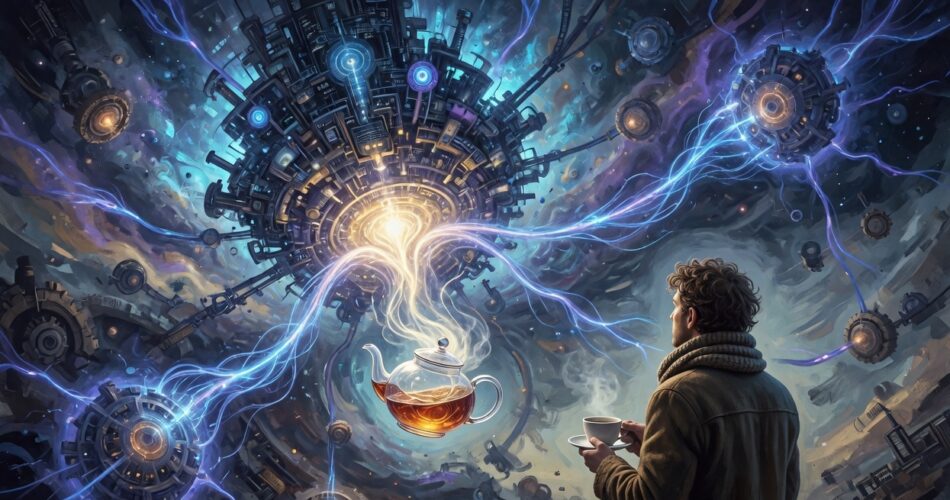
In fact, Moravec’s paradox was also evident in The Hitchhiker’s Guide to the Galaxy by Douglas Adams, where the command of Arthur Dent for a cup of tea aboard the most advanced ship of the galaxy, Heart of Gold, caused its systems to struggle and attribute disproportionate amounts of compute and inference to the process of making tea. This allocation of compute made the advanced technology divert resources from other functions. Thus, even the best ship in the galaxy could not make a cup of tea to suit a human’s, Arthur Dent’s liking. This is exactly what Moravec’s Paradox is.
World Models
Thus, even today, there are things that now AI is gradually learning to do better than humans, but a lot of things still remain. It is believed that the next leap of improvement would likely come when we will have AI world models.
World models are the next logical leap over image generation and video making models. The videos are actually mini worlds in themselves. And the images are just a timestamp of a world. So, making full-fledged worlds like we have in video games, and where AI can generate stuff not procedurally but spontaneously should be the future where we are headed to in the short term. All the frontier AI model companies are working on that. I guess the reason they have not been released out of beta versions is firstly because they are not yet polished and just crude, and secondly, and more importantly, they consume too much compute.
Energy as Currency
Elon Musk always says that the only real constraint is energy. If we can harness the energy of the Sun, even a millionth of it, we will have tremendous power at our disposal. With more energy, we will be able to do more compute. That is the reason everybody has begun to say that the orbital data centers are the future because you can have only so many solar panels on Earth, that can harness only so much energy. Also, the Sun rays have to pass the atmosphere to reach the Earth. In space, there is no such constraint. Thus, the same solar panels are able to harness at least five to six times the amount of energy that they are able to harness on Earth.
Energy & Moravec’s Paradox
Coming back to Moravec’s paradox, this energy constraint is the real reason driving the same. For an AI to do works that humans find easy such as making a cup of good tea, or even a standardized cup of tea, the AI will need to learn human nuances, how the taste buds of humans respond to tea, what goes on inside the brains of humans when they think about tea. Thus, on the surface, it may look like a simple task, but there is likely a whole evolutionary history behind this habit that humans have inculcated.
But, with better robotics, these tasks should become easier with time. There are many other tasks at which robots and AI will continue to struggle in the future such as cooking good food. Or cooking food of a very particular description, like the way my mom makes Rice pudding. There is nobody in the world who can make the exact version of the Rice pudding that my mom makes. Other people too make excellent pudding, but the nuance in the pudding made by my mom cannot be replicated by anybody else.
So, first the AI and robots will have to learn how to make Rice pudding, and then they will need to understand what exactly my mom does that every time she makes Rice pudding for her son, there is something extremely consistent, at the same time, very intangible to describe about the taste. I can just say that my mom makes Rice pudding of a particular description. And language being lossy compression cannot capture the true essence of what exactly the pudding made by her is.
Yann LeCun has said many times that AI cannot be expected to perform miracles when it is being trained only on languages. So, from languages to image generation to video generation to world generation to agentic AI to robotics, there is still a long way for the AI to cover. Of course, how much time all this is going to take is hard to predict, but one thing that Ray Kurzweil says in his book is quite true that unlike the linear development of biology, the developments in technology are almost exponential over long term. The short bumps or road blocks that come intermittently do not define the progress of technology, rather those boring phases serve a critical role in shaping the nature of technology that bounces back in the future.
Ray Kurzweil has predicted that by 2045, the AI will become smarter than all the humans combined. This does not and cannot mean that AI will achieve or unlock god mode. It will not. Humans are just not great a benchmark when it comes to measuring intelligence. We think too highly of ourselves, but ultimately, we are a bunch of monkeys who can play with metal and the things around us, better than all the other animals combined. For other animals and plants, we represent an order of magnitude shift in intelligence, and the same might hold true for AI. It will and in some cases, it does represent an order of magnitude shift in intelligence over us. But becoming all intelligent or peak intelligent is a journey rather than a destination.
As discussed, intelligence today is constrained by the amount of energy we can harness. And by that logic, intelligence will always be like that. The Kardashev levels would define the intelligence levels of any civilization in a collective manner. If we harness the energy of the Sun, then we will think about harnessing the energy of all the stars in the galaxy and eventually the universe, and then the dark matter and the dark energy, and then if there is alternate or parallel universes, those will be explored. So, it is like a Russian doll like conundrum, one inside the other and it seems like it never ends.