
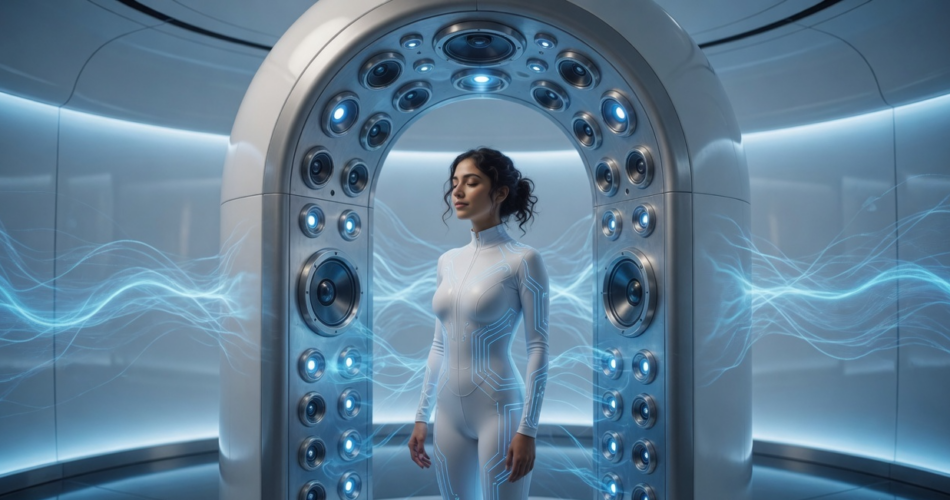
Midjourney Medical
Pathbreaking developments are becoming more common with each passing day. Midjourney recently announced a medical endeavour in which it is building a revolutionary ultrasound body scanner, known as Ultrasonic CT. This promises to be substantially better than the scanners that radiologists currently use, which involve X-rays, gamma rays, powerful magnets, and other methods far from innocuous.
It does sound like a new era in itself. Much like sonar, the technology is designed to scan every part of the body, including tissues and bones. AI will assist in interpreting and reconstructing the immense data generated when sound waves interact with the human body. Midjourney presents the experience as revolutionary: one enters the facility rather like a spa and emerges within a minute. One of the phrases they employ is the striking “Just sound and water and 60 seconds.”
As the technical video released by Midjourney explains, the system relies on transducers of the same kind found in microphones and speakers. This array of ultrasound transducers captures the data produced by sound waves passing through the body, generating a humongous amount of information, potentially up to 806 terabytes of raw data for a single individual.
This technology opens up remarkable possibilities. Disease detection can occur much faster, and treatment approaches stand to be transformed through more targeted methods. The plan is to deploy 50,000 such scanners worldwide, ultimately making advanced imaging accessible on a broad scale.
Challenges and New Future
Many people remain skeptical and question whether AI can produce fully accurate images of bones and internal structures. The key distinction, however, is that this is not the kind of AI used to generate images from prompts. Midjourney’s approach computationally reconstructs clear three-dimensional images from the enormous raw sound-wave data. The sheer volume of that data supports an exceptional level of detail.
In the near future, people should be able to undergo frequent scans of this kind, allowing tumours and their growth to be identified and addressed from the outset rather than only at a later stage. Today’s MRIs are not only costly but also time-consuming and impractical for frequent use because of the nature of the technology itself; all of this stands to change.
Although the project is still at the prototype stage and Midjourney has numerous hurdles to clear, the fact that a generative AI company can now compete with established players in the medical equipment industry illustrates the gates of opportunity that AI has opened. This mirrors a broader pattern in which more people seek initial medical guidance from systems such as Grok, Gemini, Claude, and ChatGPT than from doctors alone. It is not that doctors are inadequate, but that these frontier models possess capabilities that have earned growing trust. Doctors remain indispensable to society and will continue to be so.