
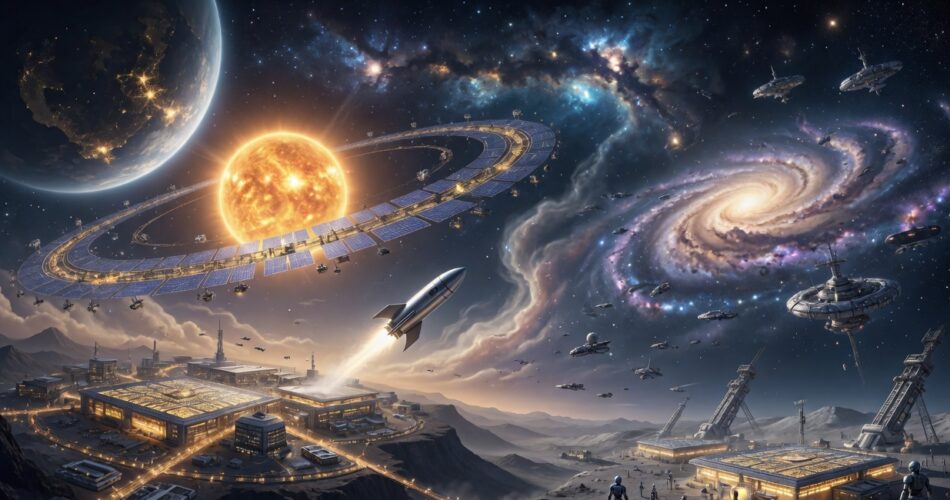
A joint venture of Tesla and SpaceX, Terafab, is grabbing the headlines for all the right reasons. Terafab is the greatest chip-building effort in the history of humanity. Its goal is clear, to make humanity a galactic civilization. Yes, you heard it right, not Type 1, not Type 2, but Type 3 civilization on the Kardashev Scale.
Background
Terafab was announced in March 2026, and apart from Tesla and SpaceX, Intel is also involved in the project. The Terafab complex is being built in Grimes County, Texas (USA) with a proposed built-up area of more than 100 million square feet. The goal is to manufacture 100-200 billion custom AI chips per year. To understand the scale, the current biggest chip-making factory in the world is Samsung’s Pyeongtaek Campus in South Korea, spread over an area of 31 million square feet. The Terafab will be more than three times its size, and at its full capacity will deliver 1 terawatt (1000 GW) of AI compute per year.
But why do we need chip-production of such gigantic proportions? The whole idea is to harness the energy of the Sun. We are already at 0.73 logarithmically on the Kardashev Type 1 scale (around 20-25 terawatts of power). We need to scale 400-500x to achieve Type 1, as Type 1 civilization utilizes around 10^16 watts of power (10000 terawatts). Earth alone cannot satisfy our ever-increasing energy consumption, and this is where the Sun comes into the picture. With the help of advanced solar panels coupled with silicon chips in space that can do inference and compute, we will be able to harness a meaningful proportion of the energy of the Sun.
Currently, the bottleneck is not on the side of solar panels. Humanity is already accelerating its production of solar panels, but it is the production of the intelligent silicon chips that is lagging behind. Only solar panels will give us raw electricity, but without effective means to use that electricity to further build our civilization, we will be stuck. This is where a civilizational project like Terafab comes into the picture. Most of the chips built there will be used for space computers, and a small proportion will be used to build Optimus robots.
Starship will also be critical here as it will be the vehicle that will be carrying all the payload involving solar panels and chips to space. Without harnessing the energy of the Sun, it will not be possible to make life multiplanetary and expand the horizons of consciousness. We need both biological intelligence as well as silicon-based intelligence to make life habitable on places other than Earth. Once the Terafab is complete on Earth, it will help humanity in unlocking the orbital economy and bring an age of abundance.
Vision
Terafab is being built with long foresight and vision. Elon himself has said that in the future, a Terafab, even bigger and more advanced, will also be constructed on the Moon. Lunar mass drivers and Starship will help in transportation of goods required for the same.
A question that people ask often is why focus so much on chip-production. The answer is that any multiplanetary presence requires systems that can act with a high degree of precision. Real-time human control and monitoring is not enough, and local autonomy is the only thing that can help us populate the galaxy. Semiconductor chips provide the densest and most energy efficient computation on a physical substrate. Without abundant chips, our civilization cannot move fast enough to cover the vast galactic and cosmic distances.
Think of our galaxy as an Age of Empires game where the empire is so vast that without proper information management, it will be impossible to take care of the same. Chips are the practical physical means of solving this information problem at the necessary density, speed, and efficiency. Without such computational substrate, the required closed-loop control systems cannot exist at the scale needed for survival, let alone expansion.