
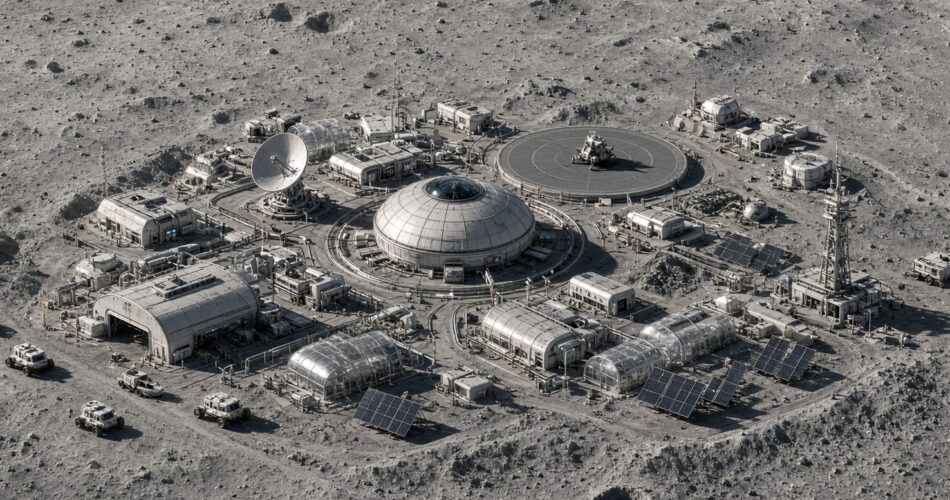
The world is changing faster than we can imagine. Civilizational-level plans are being made in the realm of space. Jared Isaacman, the NASA Administrator, has made an engineering claim that the Moon is the best and the nearest place for us to practice living and habituating in space before going to farther celestial bodies like Mars.
Starting Point
To make sci-fi real and have a Star Trek-like reality for us, the Moon is clearly the starting point. It is a common misconception that the Moon is barren dust; it is not. It has water in the form of ice in permanently shadowed regions (PSRs). Lunar regolith is more than 40% oxygen, bound in silicates and oxides, which can be used for manufacturing breathable air. It also has most of the metals that are needed for building roads, structures, landing pads, etc. And as and when nuclear fusion becomes a commercial reality, the Moon even has large quantities of isotopes of helium that could act as a fusion fuel.
Despite all the above, the Moon is not a place that could become the final habitat of humanity. The resources on it are clearly limited, and the lack of atmosphere makes it more of a pit stop than the finish line.
Even so, its distance from the Earth is one of the biggest positive factors that makes it the top contender for setting up humanity’s first base on another celestial body. A one-way trip to the Moon is a matter of just 3 days, the communication delay is a mere 1.3 seconds, and launch windows are frequent.
Another massively important factor that goes in favour of the Moon is its low gravity. Rockets will require way less escape velocity to escape the clutches of the Moon than of the Earth. Thus, it can act as humanity’s launch pad for farther missions to planets like Mars and beyond.
Logically, to make proper and permanent launch pads and landing pads on the Moon, we will need to stress test the environment there. It will have to be seen, by actually experiencing it, which systems survive the harsh climate of the Moon, its electrostatic dust and thermal cycling.
Need for a Moon Base
The Moon will also teach us how to live on a celestial body with closed-loop air, water, waste, and food systems. Humanity will learn how to survive when the resupplies get delayed. Nuances of crew psychology would be understood under the strenuous conditions of the Moon. Abrasive dirt looks simple, but to deal with it on a day-to-day basis will be a challenge. Those are the kind of things that will prepare us for Mars.
Also, ISRU (In situ resource utilization) capabilities cannot be developed overnight. A whole new lunar economy will have to be created. Investors will put in their money, businesses will be set up, customers will arise. Power and communications will have to be set up to plant the seed of industry.
Further, ISRU processes such as prospecting, excavating, processing, and storing through dust and night will be learnt. For context, a lunar night is 14 Earth days of darkness. There is no solar energy available during that time. It is the reason that we cannot solely rely on solar power, and adequate provisions for nuclear power will also have to be made.
The kind of space architecture we need is still not clear and will not become clear unless we actually start iterating on a celestial scale. We will find many flaws in our original designs that would require correction. That is why rushing to Mars is not feasible currently. Of course, humans will keep sending robots, maybe even Optimus robots in the future. But for humans to settle, we will need to do a lot of homework on the Moon to prepare ourselves better.
Space is the Final Frontier
And all this will have to be done in a manner that the interests of entire humanity are secured and not just one nation alone. China, too, is planning to have its own lunar base. Competing interests will have to be reconciled and cooperation at the highest levels would be required.
The bottom line is that the Moon is close enough to experiment with our plans and make them better. Apart from being an engineering problem, the problem of space colonization is also one of mindset. Today, most people express disbelief when colonization of Mars or the Moon is talked about. Unless real stuff is actually shown to the common people, confidence levels in our becoming a spacefaring civilization will not increase. This is important, as a better mood on Earth about space would motivate and have network effects of sorts in accelerating our interstellar progress.