
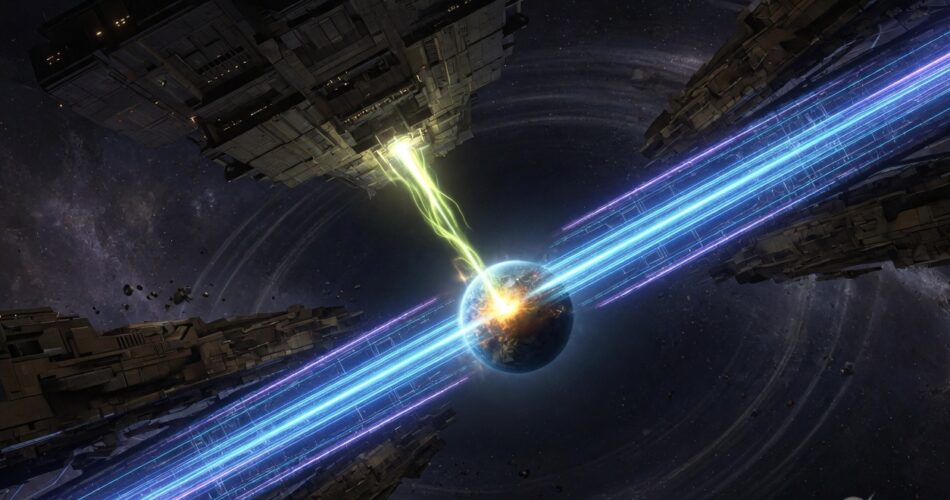
Don’t Panic!
In Douglas Adams’ The Hitchhiker’s Guide to the Galaxy, it turned out that Earth is actually a gigantic supercomputer. That said, in the story, just a few minutes before Earth was due to complete its programmatic calculations, the Vogons demolished the planet to make way for a hyperspace bypass. Fate, however, loves irony. Perhaps Earth really is a giant supercomputer, and we are its components, each performing calculations individually yet contributing, in our own way, to the sum total. We are also extending our intelligence through AI, machines, and robotics. Although we have not yet encountered any Vogons, we must make life multiplanetary before they could arrive to clear a path for a hyperspace bypass, thereby significantly improving our species’ chances of long-term survival.
The Reality
To turn this multiplanetary imperative into a practical reality that protects and extends our growing computational presence across the cosmos, Elon Musk recently observed that one million tons to orbit should be possible in roughly five years. This target is deeply rooted in the fundamental structure of our Solar System. The Sun accounts for 99.86 percent of its total mass and roughly 99.93 percent of its total volume, leaving planets, asteroids, comets, and all other bodies to constitute only a tiny fraction. Life itself remains almost entirely dependent on the Sun, and without its light, the conditions that sustain us on Earth would not exist. The entire planning philosophy behind SpaceX and Starship therefore revolves around this central fact. In the future, the cargo Starship will most frequently carry to space will be solar panels and computing chips, the essential building blocks for expanding our intelligence and energy infrastructure beyond Earth. As I discussed in an earlier article, Starcloud and SpaceX are together advancing humanity toward a Kardashev Type 2 civilization.
Central to reaching that threshold is the Sun’s unmatched power as the Solar System’s primary energy source. If we could harness even a millionth of its output, we would come remarkably close to a Kardashev Type 2 civilization, commanding more than a thousand times the total energy consumed by our current global society.
Realizing even a fraction of that potential at civilizational scale will require placing vast quantities of infrastructure into orbit. In this context, the operational meaning of the one-million-ton annual target becomes especially clear. The figure refers to yearly throughput in metric tonnes. With Starship’s design capacity of 100 to 150 or more tons to low Earth orbit per flight, achieving one million tons per year would demand thousands of launches annually. Once the system reaches full cadence, operations would settle at roughly 10 to 20 flights per day, high frequency launch activity comparable to major airline schedules, but executed with fully reusable rockets.
The Progress
It is exhilarating to observe how far the effort has already progressed. Starship is a true engineering marvel: the most powerful rocket ever developed, a two stage super heavy lift vehicle whose Super Heavy booster alone integrates 33 Raptor engines while the upper stage carries approximately six more. As of June 2026, twelve integrated test flights have been completed, and the vehicle continues to advance through its V3 configuration with steadily improving reliability. At the same time, SpaceX is scaling production toward hundreds and ultimately more than a thousand vehicles per year. Remarkably, the company is already delivering more than two thousand metric tons of payload mass to orbit annually, accounting for the vast majority of all mass placed into orbit worldwide in 2025. Yet the goal of one million tons per year still represents an increase of roughly three hundred to five hundred times over today’s global launch capacity. This extraordinary expansion is precisely what will be needed to build the orbital infrastructure capable of harnessing the Sun’s energy, extending our intelligent systems into space, and securing a genuinely multiplanetary future, ensuring that, whatever cosmic absurdities may lie ahead, our species will have already spread its presence among the stars.
To read more about cosmic absurdities, you can click here.